Belsize Stories 4:
Japanese prime minister visits at the crack of dawn
by Jill Banerjee
And other stories...
I first met my husband at a party in Primrose Gardens in the 1960s. He was part of the small community of Bengali Indians drawn to Belsize, and knew Bidhan Bose well (p.44 Belsize Remembered) – he was the “go to” person for many of the group. Later we both had bedsits on Belsize Lane, an area where many colourful characters lived then, including the man who could regularly be seen walking his chimpanzee.
A year on we were married in St Peter’s Church, Belsize Square, and moved into a flat at No.11 Belsize Avenue. We lived in the avenue for over twenty years. I remember the “exotic” continental delicatessen in Belsize Village, where my husband purchased my first taste of Cheesecake! Also buying wonderful bread from the bakers, Rumbolds, the Beer & Curry restaurant and of course the Belsize Tavern, where my husband Bemol was befriended by a jolly group of pals who met there regularly. These included Alan the Hat, Elephant Bill, the cartoonist Tony Holland (my son still has a cartoon Tony did for his birthday), Michael Taylor, Richard Quick and Douglas Kerr.
In the 1970s I became involved with the Belsize Village Street Festival. This was organised by local people with support from the council. In those days it was still a through route for traffic, and permission was needed to close the village. Barriers were erected, and a small stage built, all courtesy of Camden Council. The whole area was decorated with bunting and balloons. There were many colourful craft stalls, and street food. The entertainment was eclectic, ranging from rock bands, children’s fancy dress, steel bands and Flamenco dancers to the Trad Jazz band, The Temperance Severn. Of course, being Belsize, many well known faces from stage and screen could be seen enjoying the festivities, and one year my husband was instrumental in getting the model “Twiggy” to open proceedings.
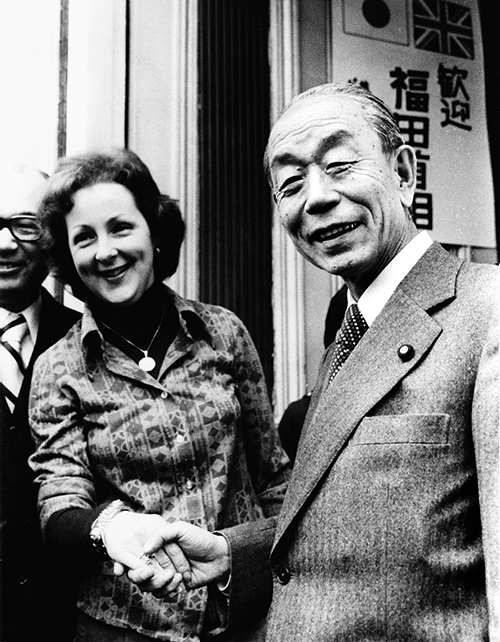
Jill Banerjee and the Japanese prime minister at No.11 Belsize Avenue, May 1977
Our five minutes of fame came in May 1977, when during a big international summit, some dignitaries decided to trace or retrace their connections with the UK. The American president went to Ireland, and the Japanese prime minister remembered his student days in a flat at No.11 Belsize Avenue!
There was a telephone call on the Saturday evening asking if arrangements could be made for a possible visit by Mr Fukuda, which would have to be very early Sunday morning as that was the only time he had (my young son took the call and I didn’t believe him at first). This was lucky as it gave me time to persuade a kind Japanese neighbour to pen a few words of welcome, which we fixed to the front door. That call was followed by another at the crack of dawn on the Sunday to confirm.
Mad panic ensued, get dressed, tidy up etc. the exterior of the property was silently inspected by his security men and the whole road temporarily sealed off. Everyone else in the house was still asleep, while we had a quick photo of him shaking hands with me on the front door step, and handing over a small gift. The gift however was for my husband, it was a Japanese digital watch. The whole event was reported on the Heathman’s Diary page of the Hampstead & Highgate Express at the time.
I worked for many years in Camden libraries, and although based mostly at Swiss Cottage and Kentish Town, like Marion Hill, I also helped out at the lovely Belsize branch, during some of the times when it was under threat.
Next is a follow up by Simon Trevor Roberts to the story of the painting A New Neighbourhood as told in BELSIZE Remembered
Here we introduce the story with a quote from Toni Hubernan:
"East painted A New Neighbourhood in the mid 1880s. It is of a view from his rear studio window (which would have overlooked the nascent Eton Avenue), depicting a single house under scaffolding being built, with a row of houses in Fellows Road in the distance. It may be the earliest known painting of Eton Avenue. In fact there are four versions of it, one of which is reproduced here… In the early days of Eton Avenue houses had names, not numbers, so it’s very difficult to establish which buildings existed. But No.55 has been confirmed as the subject of his painting – it is now the Trevor Roberts School."
– Toni Huberman, BELSIZE Remembered p.8.
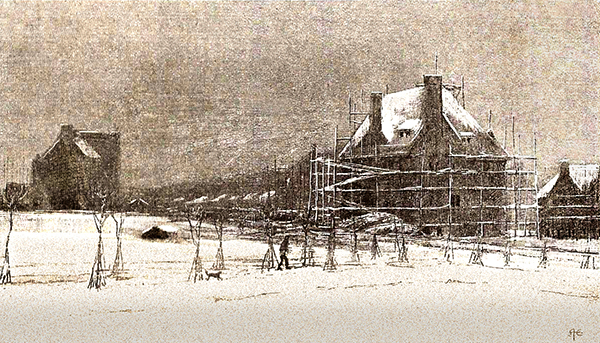
A New Neighbourhood, Alfred East c.1885
The Trevor Roberts School
by Simon Trevor Roberts
My father, Christopher Trevor-Roberts, moved his school to No.57 Eton Avenue in 1981 from its previous location in The Vale of Health, Hampstead. The building was partially derelict at the time, with small trees growing through the roof, but the complete refurbishment was masterminded in time for the first day of term by his sister, Brenda Davidson, RIBA, who lived at No.44 Primrose Hill.

Conservatory corner of the Trevor Roberts School, No.57 Eton Avenue
The property originally belonged to Eton College, as had much of the land in this area, hence the name of the road and, I believe, of nearby Provost Road. There had been a school on this site previously and we were told there had also been a Jewish school here after the war – a mezuzah can still be seen on the front door frame under many layers of paint.
My father took over No.55 Eton Avenue when the South Regional School for the Blind disbanded in the nineties and it was very rewarding to be able to return the large rooms to their former glory – classrooms need to be larger than offices! This building also had a long educational history – the Windrush School was housed at this address in earlier decades.
The designs of both buildings were apparently part of an architects' competition which perhaps explains their individuality, not to say quirkiness. They are extremely well built by William Willett and Sons – no bricks from the bottom of kilns used here, doors and framing thicker than their modern equivalents and detailing of a very high standard, which is just as well with active young hands and feet busy during the course of the working day.
Two stories follow about the fish and chip shop that some may remember from the 1980s – one by a resident and another by an New York-based writer who lived in the area for nine years.
Maxwells of Ealing
by Paula Lush
I moved into beautiful Belsize Park in 1994, having strayed into the area from a keep-fit class in Swiss Cottage. For those who believe in spiritual matters or a ‘gut feeling’, that is what came over me when I walked down a few streets leading to this fantastic area with its wonderful café society. In the present Facebook and Twitter age, when people imagine that their friends are really interested in the meal they are eating, there has only been one venue in my experience worthy of my tweeting about – a super little eatery called Maxwells of Ealing across the road from Belsize Park Tube station.

Maxwells of Ealing on Haverstock Hill photo: ©1985 Photographer695, Flickr
In my humble opinion it was the most wonderful fish and chip restaurant in North London in the 1980s and 90s. The ever-chatty manager served delicious crisp and plentiful chips, alongside a wide variety of fish, which I’ll come to later. The smartly uniformed waitresses bustling around the lovely little black and white tiled restaurant completed the blissful experience. That is, if you’d opted for an alternative to the satisfaction of walking away nursing your take-away, the taste and smell of which I can still conjure up many years later.
In those days a fish and chip shop served a choice of fried fish with all the ‘proper’ accoutrements – mushy peas and not burgers – and it was a mouth-watering experience to beat all others. By contrast, I found one local establishment a while ago who had never heard of scampi and was totally uninterested in the idea of putting them on the menu. How different from Maxwells, who always delivered service with a smile (and eye contact).
It was a sad day indeed when six months after I moved to Belsize Park, and after very many take-aways on my part, Maxwells closed. I can still recall the joy of emerging from the tube station on a Friday evening and seeing the restaurant full with diners and many others queuing outside. I’ve never found anything locally that is remotely comparable.
Jolly Good Fish 'n' Chips
by Timothy Harper
(New York, May 1988)

Photo: Rathfelder CC-BY-SA-3.0
Fish and chips are to Britain what chopped liver is to New York or barbecue to Texas – national foods. But the most popular London tourist areas have few, if any, decent fish 'n' chips shops, the kind where Londoners would actually eat. Don't, whatever you do, eat at the fish 'n' chips shops around Leicester Square, Charing Cross, Covent Garden, Piccadilly Circus, Knightsbridge, St. Paul's or any of the other usual tourist haunts. The fish is almost always frozen, deep-fried in heavy oil and then left to congeal.
To sample honest fish 'n' chips – and explore the sort of neighbourhood where you might live if you moved to London – take a short ride on the Underground's Northern Line to Belsize Park. Outside the station on Haverstock Hill, buy a newspaper and say hello to Dick Kelly, the compact man at the little blue newsstand. He'll welcome you to the neighbourhood, crack a joke and offer whatever directions you need to the park or to the Hampstead shops.
You won't need directions, however, to the fish 'n' chips shop. Maxwells of Ealing is right across the street from the station. If you want a beer or a bottle of wine with the fish, stop first a few doors down the hill at The Grapevine, a liquor store run by Dan Elbaz, who always has something special, from French table wine to Czech beer.
At Maxwells, bypass the takeout queue and grab one of the tables for a sit-down meal. Pause at the counter and introduce yourself to Roy Hill, the guy who manages the shop and takes pride in the fish he serves. Unlike all but a handful of other London shops, his fish is fresh every day, delivered directly from North Sea trawlers before dawn. Hill himself goes to the fish markets, takes deliveries and then fillets the haddock and cod in the back of the shop.
He offers daily specials that are served on the bone but always seem worth the effort, including treats such as Dover sole and Aberdeen skate. Hill is a friendly sort who doesn't mind if customers stick their heads over the counter and ask what they should have.
"Got a lovely piece o' haddock for you," he might say, delving into the drawer behind him to pick out a prime fillet he has been saving for someone who asks. At the table, a waitress – likely as not Hill's wife, Carol – uncorks the wine and pours the beer for no extra charge. (Soda and fruit juices are on the menu.) In a few minutes, the generous portion of lightly battered, fried fish and the crisp hot thumb-sized fries are in front of you.
There's perhaps 300 per cent less grease in Hill's food than in the fish 'n' chips shops in tourist areas, and the difference between fresh and frozen fish is unmistakable. Small wonder that Meryl Streep makes Maxwells a regular stop when she's in London, or that a Texas oilman recently tried to talk Hill into moving to Dallas. (Hill did some research and turned down the offer on the grounds that he would have to use at least some frozen fish instead of all fresh.)
For a meal that costs less than $3.00*, it's one of the best fast food bargains anywhere. The only caution is that the shop is open only from noon to 2:30pm and from 5pm to 10:30pm. It's closed on Sundays. If you're finishing your meal at either the afternoon or evening closing time, there's a fair chance of getting Hill to escort you a block or so down Haverstock Hill for a pint or two at the Haverstock Arms, a local pub where American visitors are still enough of a rarity to make casual conversation easy with the regulars.
*US Dollar exchange rate on 7 May 1988 was 1.8635.
About the author of Jolly Good Fish 'n' Chips
Tim Harper is a New York based freelance writer who lived in Belsize Park and Hampstead 1984-1993. This story originally appeared in the Washington Post in May 1988, and drew scores of American tourists who wanted to shake hands with Roy Hill and sample his fish 'n' chips.
Tim adds: I've lost track of Roy the Fish; last I heard, years ago, he was actually running a fish 'n' chip shop in Ealing. His consumption of pints while working was prodigious. He once told me he had a reason for drinking cider. "You can have 10 pints during the day, and the first one the next morning tastes just as good." He was part of a great group of Haverstock Arms pals, including Dick the Paper (newsstand), John the Drummer, Tony Ashton, and a dozen others. Chris Evans used to hang out with us when he first came down to London.
Copyright of these stories belongs to the respective authors.
If you have an Interesting story to tell about Belsize Park,
you can submit it here for possible publication online
BELSIZE Remembered is available from Daunt Books,
Waterstone's Hampstead and from Amazon.