Belsize Stories 3: Remembering England's Lane
by Gilbert Jessup

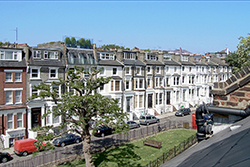
England's Lane as it was in 1895 with landau
I was born in No.12 England’s Lane in March 1935. The few rooms we occupied were on the first floor over a laundry. I particularly remember the row of trees across the road, behind which were the relatively grand houses of Chalcot Gardens.
In the 1930s and 1940s almost all the shop owners lived above their shops, except us. On the right side of No.12 was Beaton’s the Chemist, with Mr and Mrs Beaton occupying the rooms above. Next to them was Barrett’s the Butchers, with Mr and Mrs Barrett living over their shop. My mother cleaned for the Barretts. Ward’s the newsagents had the Wards living above them plus Mr Ward’s sister. In my secondary school years I did a paper round for Mr Ward every morning covered the length of Belsize Park Gardens. I set out with a pile of papers that became lighter and lighter as I made each delivery until reaching Belsize Village. On Sundays, when the daily rate paid was double and the papers were a lot heavier, I did a second paper round in Antrim Mansions.

England's Lane c.1900 – Barrett's the Butcher was located by the small barrow
My mother was born in Elizabeth Mews in the rooms above the stables in 1895. Elizabeth Mews runs parallel to England’s Lane, behind the shops. The building where she was born and lived was directly behind our house, so when she married she only moved about 20 yards. She lived in England’s Lane the rest of her life until she died age 88. She was the youngest of twelve children, of which seven survived to adulthood – fairly typical of Victorian working class families.
One of my earliest memories was the outbreak of the Second World War when I was four and a half. I recall walking up Haverstock Hill with my father past Belsize Park Station where people were out on the pavement filling sandbags. My father, who at the time was 43 years old, was considered too old to be conscripted into the armed services so he became a War Reserve Constable for the duration of the war. He was based at the former Police Station on the corner of Rosslyn Hill and Downshire Hill. He had fought in the army throughout the First World War so reckoned he had ‘done his bit’.
The eldest of my two brothers was eighteen at the beginning of the war and he was frantically busy installing blackout curtains to homes. He had been working as a carpenter. He had left school at 14 as my parents had done.
Although food was rationed during the war it had far less effect on working class families as they had found it difficult to earn enough to feed themselves even before the war. As a result of wartime rationing we probably had a more balanced diet. And we kids benefited from free orange juice and cod liver oil. The most dangerous occasion I experienced was when a bomb dropped on Fellows Road. It was a pretty large one, described at the time as a landmine. It wiped out half a dozen houses and smashed all our front windows, inches from where I was in bed sleeping. Luckily there were heavy blackout curtains (installed by my brother) between me and the window so I was unharmed, if a bit surprised. But sadly one or even two of my classmates were killed by that bomb.
On another occasion my second brother Ron (six years older than me) was coming home from school along Parkhill Road when a bomb dropped behind him at a spot he had passed only five minutes before. That was where the estate of council flats is now located in Parkhill Road.
The building in which we lived had once been a bakers shop. It had a basement with a hollowed-out space that extended under the pavement where the ovens had once been. We used to sleep in these ovens on some nights (although there was not much room) in the belief that if we were bombed and the house fell down on top of us we would be protected. Fortunately, it was never put to the test as we never seemed to be there when it really mattered.
My father had an allotment during the war on Parliament Hill. There was a large expanse on the southern slope facing the athletics track devoted to allotments. The top of the hill was a fenced off area with search lights and ack-ack guns were installed to shoot down enemy aircraft.
Many families who could afford to do so moved out of London during the war. The houses in Eton Avenue, which starts at the end of England’s Lane, were almost all empty. This suited us kids very well as we played in the gardens and even in some of the houses. We also had bomb sites to play on, the nearest in Belsize Park Gardens, Fellows and Adelaide Roads.

England's Lane around 1906
England's Lane had quite a village atmosphere when I was young. All the shop owners knew each other and everyone did their shopping along the street. We had butchers, bakers, greengrocers, general grocers, hardware shops and newsagents – in fact just about everything needed in those days. If we wanted something more exotic we walked along to John Barnes on the Finchley Road. We had no fish and chip shop though – the nearest one was in Fleet Road. The atmosphere of the street was captured by Joseph Connolly in his novel England’s Lane (Riverrun Publishers, 2012), although it mostly takes place in 1959 by which time things were beginning to change. The novel probably refers to what it was like about ten years earlier.

Primrose Gardens in 2012
Most of my friends in the early war years lived in Primrose Gardens (or Stanley Gardens as I first knew it) which leads off England’s Lane. We used to meet in the green area, a narrow elongated oval that runs down the middle of the road. It was overgrown and pretty wild during the war, which suited us. It also had an air-raid shelter at the southern end.
At one stage, it must have been 1944 or 1945 we used to play cricket across England’s Lane outside my house on Sundays whenever there were very few cars passing or parked. The wicket was chalked on the Chalcot Gardens wall while we bowled from the shop side. We paused every 15 minutes to let the bus through, the 187. On most weekdays I recall there was a horse and cart parked outside our house in England’s Lane loading up to make deliveries of washing from the laundry.
I played chess for Hampstead which had a chess club that met in Burgh House and played with a number of distinguished people. C.M. Joad was a member who was well known as broadcaster (the Brains Trust) at that time. Then these was the Penrose family – Lionel Penrose was a professor of eugenics at UCL. Jonathan Penrose was the chess prodigy who became British champion several times and an international master. His older brother Oliver (now Sir Oliver) was also a member and went on to become the country’s leading mathematician.
Another member was Conel Hugh O'Donel Alexander, the ex-British Champion. One evening when the club was fairly empty I was playing a social game of chess, Alexander was playing a game on the next board. He said he would not be able to play for Hampstead in the future as he was being posted to Cheltenham. I understood he worked at the Foreign Office but had no idea what he did. It was not until some 30 years later that I realised that his reference to ‘being posted to Cheltenham’ actually meant he was appointed as Director of the Communications Centre (GCHQ). I also learned later that he worked on the German Enigma machine at Bletchley Park. I think he was Alan Turing’s boss. Of course these things were kept secret until many decades after the war.
Copyright of these stories belongs to the respective authors.
If you have an Interesting story to tell about Belsize Park,
you can submit it here for possible publication online
BELSIZE Remembered is available from Daunt Books,
Waterstone's Hampstead and from Amazon.